3 days in Kyoto: an itinerary timed to opening hours
In short: TourMyDay's 3-day sample plan for Kyoto has 18 stops, each timed to its opening hours and in walking order, starting at Ginkaku-ji Temple at 9:00 AM.
Written with AI from TourMyDay's own city data (sights, opening hours, the app's planner), not by a local expert. How TourMyDay works →
Kyoto is a city to explore on foot. Temples, shrines, gardens and old streets sit close together, so a day can move from one famous site to the next with short walks between them. Many of the sights are religious buildings, so expect quiet courtyards, shoes off in some halls, and crowds at the most famous spots by midday.
The sights below add up to a mix of Zen gardens, hilltop temples, a samurai-era castle, an imperial palace and the vermilion torii tunnels of Fushimi Inari-taisha. Opening hours differ a lot from place to place and across seasons, so the order of visits matters. The sample plan puts the earliest-closing sites where the morning light and daylight hours allow.
Sample itinerary
Planned by the TourMyDay app around real opening hours, in walking order, with a lunch break.
Day 1: Eastern hills and Fushimi Inari
Start with the Silver Pavilion, Heian Jingū, Yasaka Shrine and Kiyomizu-dera on the eastern side, then finish the day at Sanjūsangen-dō and the torii gates of Fushimi Inari-taisha.
- Ginkaku-ji Temple
- 25 min walk
- Heian Jingū
- 19 min walk
- Yasaka Shrine
- 18 min walk
- Kiyomizu-dera
- 🍽️ Lunch: 舌切茶屋
- 24 min walk
- Sanjūsangen-dō Temple
- 34 min walk
- Fushimi Inari-taisha
Day 2: Zen gardens and the Golden Pavilion
Begin at the rock garden of Ryōan-ji, then visit Ninna-ji, Myōshin-ji and Kitano Tenmangū, before ending at the Golden Pavilion of Kinkaku-ji and the sub-temples of Daitoku-ji.
- Ryōan-ji Temple
- 15 min walk
- Ninna-ji Temple
- 13 min walk
- Myōshin-ji Temple
- 24 min walk
- Kitano Tenmangū
- 🍽️ Lunch: 桜井屋
- 21 min walk
- Kinkaku-ji Temple
- 25 min walk
- Daitoku-ji Temple
Day 3: Palace, castle and the Higashi-Nishi temples
Spend the morning at the Kyoto Imperial Palace and Nijō Castle, continue to Tō-ji, then Nishi Hongan-ji and Higashi Hongan-ji, and finish at Kyoto Tower.
- Kyoto Imperial Palace
- 34 min walk
- Nijō Castle
- 🍽️ Lunch: 和楽庵
- 18 min by taxi
- Tō-ji Temple
- 22 min walk
- Nishi Hongan-ji Temple
- 7 min walk
- Higashi Hongan-ji Temple
- 5 min walk
- Kyoto Tower
Top sights
Kiyomizu-dera
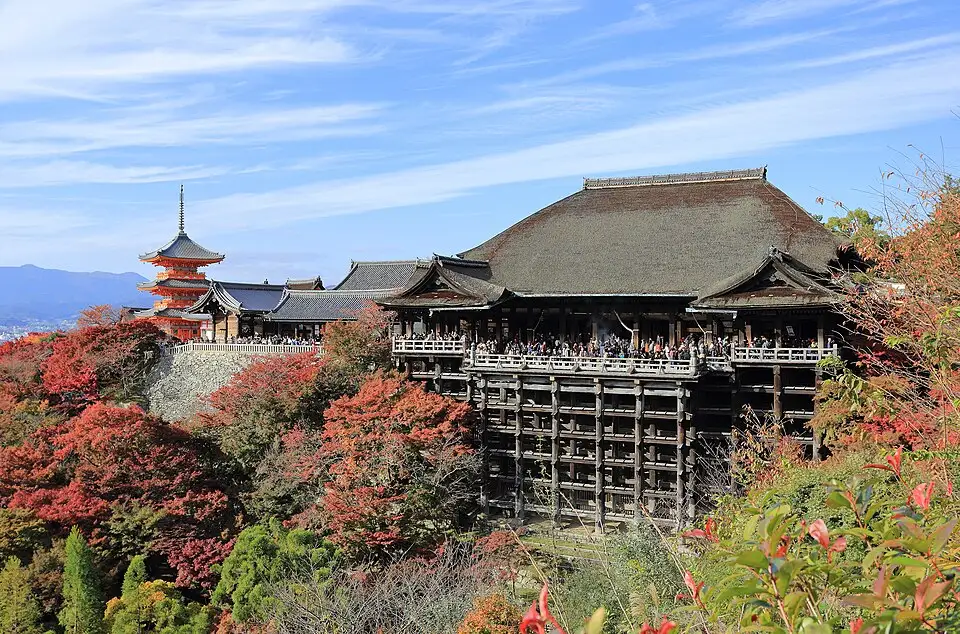
Hillside temple known for its wooden stage over the valley and the Jishu Shrine. Go early to avoid crowds and expect steep slopes on the approach.
🕘 Mo-Su 06:00-18:00Kinkaku-ji Temple
The Golden Pavilion, a gold-leafed villa reflected in a pond. Closes at 17:00, so visit in daylight; the garden walk is short and easy.
🕘 Mo-Su 09:00-17:00Fushimi Inari-taisha
Famous for its long tunnels of vermilion torii gates climbing Mount Inari. Hours aren't listed here, so check locally; the upper paths take a good hour or more.
Nijō Castle
A castle with a moated enclosure and the Ninomaru Palace, known for its nightingale floors. Plan for a guided walk through the palace interior.
🕘 Mo-Su 08:45-17:00Ryōan-ji Temple
Home of the famous rock garden of fifteen stones seen from a veranda. Sit quietly and look from different angles; it is small and gets busy.
🕘 Mo-Su 08:00-17:00Daitoku-ji Temple
A large Zen temple complex with several sub-temples and gardens. Choose a few sub-temples to see rather than trying to cover all of them.
Tō-ji Temple
Home to a five-storied pagoda, the tallest wooden pagoda in Japan, and a Golden Hall. Opens early and closes at 17:00.
🕘 Mo-Su 05:00-17:00Hōkō-ji Temple
Known for the Kyoto Daibutsu and the Mimizuka ear mound. Hours aren't listed here, so check before you go; it is a quieter stop.
Kyoto Imperial Palace
The former imperial residence set in a large park with the Shishin Hall. Open late, so it suits a relaxed evening or a later start.
🕘 Mo-Su 09:00-21:00Ginkaku-ji Temple
The Silver Pavilion, set in a moss and sand garden on the eastern hills. Winter hours are shorter, so arrive earlier then.
🕘 Mar-Nov 08:30-17:00; Dec-Feb 09:00-16:30Ninna-ji Temple
A large temple with a Golden Hall and the Reihōkan treasure hall, set in a calm grounds. Easy to combine with nearby sights.
🕘 Mar-Nov Mo-Su 09:00-17:00; Dec-Feb Mo-Su 09:00-16:30Heian Jingū
A Shinto shrine with a large vermilion gate and the Shin'en garden. Hours change by season, so check the day's times before you leave.
🕘 Mar 15-Sep 30 Mo-Su 06:00-18:00; Oct 01-Oct 31 Mo-Su 06:00-17:30; Nov 01-Feb 14 Mo-Su 06:00-17:00; Feb 15-Mar 14 Mo-Su 06:00-17:30Tips
- Start each day early, since most temples close between 16:30 and 17:30 and several close before dinner.
- Check opening hours for the season you travel in, because some sites shorten their hours in winter.
- Plan for steep slopes and long walks between the eastern temples, and wear comfortable shoes.
- Expect to remove shoes at some halls and to be quiet in gardens, and carry a little cash for small fees.
Best time to visit
Spring and autumn are the most pleasant seasons for walking, with mild weather and good light. Mornings are best for visiting temples, before the crowds and the midday heat.
Plan your own days here, offline
TourMyDay plans every day around your taste and pace, with real opening hours, and it works with no signal.
Download on theApp StoreQuestions
How many days do you need in Kyoto?
Three days gives time to see the main temples and shrines without rushing. Two days works if you focus on the most famous sights only.
Can you see Kyoto on foot?
Yes, many of the sights are in walking distance of one another within each area. Some sites, like Fushimi Inari-taisha and the eastern temples, require longer walks or steep climbs.
What is closed when?
Most temples close in the late afternoon, usually between 16:30 and 17:30, and hours vary by season. Check each sight's current hours before you go, because some listings here don't show them.
Is it doable offline with TourMyDay?
Yes, TourMyDay plans the day around real opening hours and walking order, and it works offline on your iPhone once the plan is made. Check hours before you leave in case of changes.
How this guide was made: the sights and their opening hours come from the city's TourMyDay download (OpenStreetMap, Wikidata and the places' own websites), the sample plan was made by the app's planner, and the text was written with AI from those facts. How TourMyDay works →